Personal Representative, Roles and Key Duties
If you have been named as a personal representative, you are being trusted with one of the most important roles in estate administration. You may be dealing with probate, paperwork, property, family expectations, financial accounts, and sensitive personal information, all at a difficult time.
In simple terms, a personal representative is the person legally responsible for administering someone’s estate. In England and Wales, that usually means either an executor, named in a Will, or an administrator, appointed where there is no valid Will or no executor able to act.
For many people, the legal side is only part of the challenge. Important information may be scattered across paper files, devices, email accounts, solicitor correspondence, insurance records, and password managers. That is one reason modern planning matters. Services like Holdfast help people organise personal records, legal details, credentials, letters, and instructions in one place, with AES-256 client-side encryption, zero-knowledge architecture, and controlled sharing so each recipient sees only what they are meant to see.
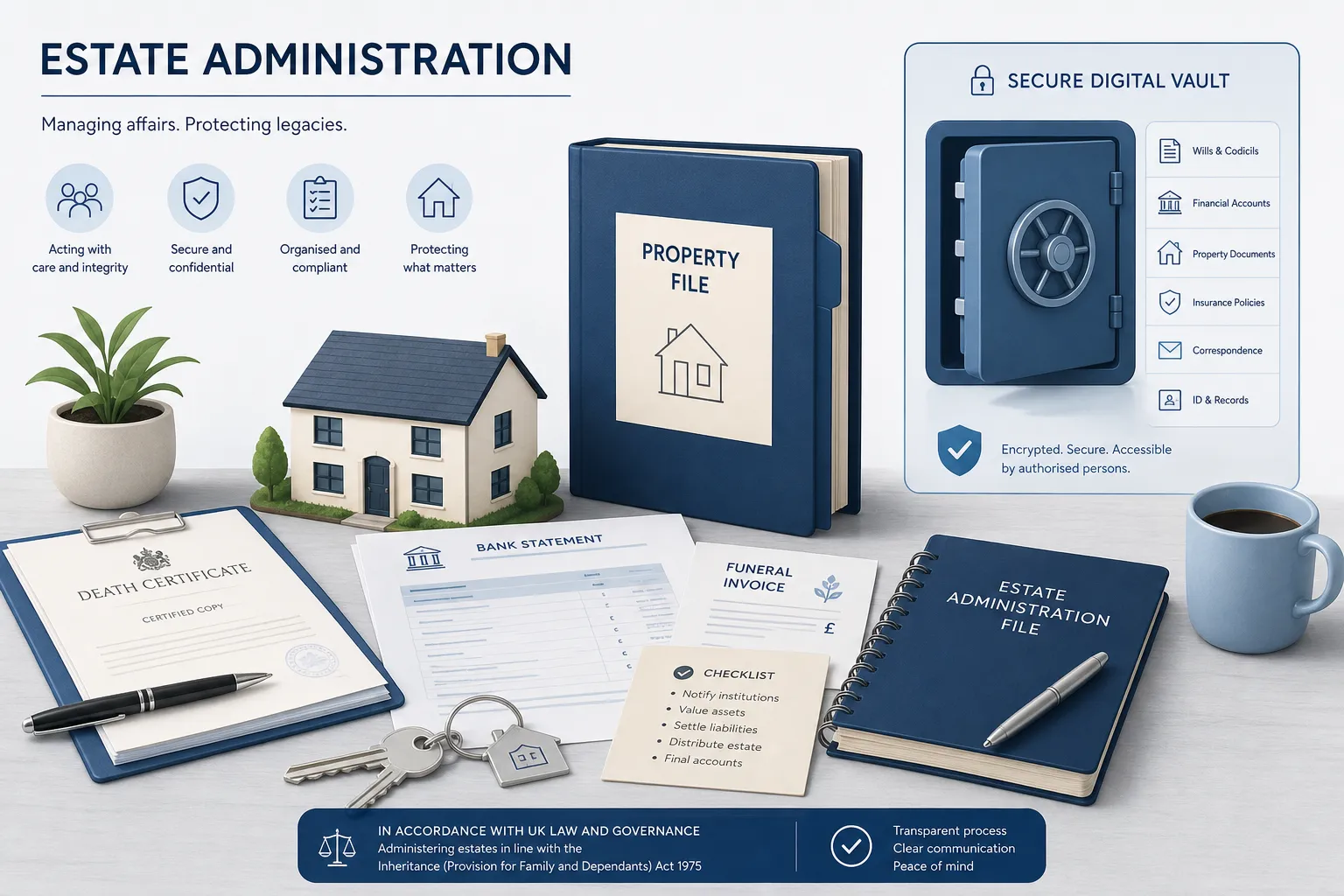
What is a personal representative?
A personal representative is the person, or sometimes several people, who has legal authority to deal with an estate.
Executor vs administrator
Role | When they act | Authority granted |
|---|---|---|
Executor | When there is a valid Will naming them | Usually applies for a Grant of Probate |
Administrator | When there is no valid Will, or no executor can act | Usually applies for Letters of Administration |
Both roles involve broadly the same practical work. The main difference is how authority arises.
Why the role matters
A personal representative is responsible for making sure the estate is handled correctly, which includes:
identifying assets and liabilities
safeguarding property and possessions
dealing with tax and debts
applying for the correct grant, where needed
distributing the estate to the right people
This is not a ceremonial title. It is a legal responsibility, and mistakes can create personal liability.
The core duties of a personal representative
The role follows a fairly clear sequence, although real life often makes it less neat than the checklist suggests.
1. Find the Will and confirm authority
The first task is to establish whether there is a valid Will and who is entitled to act. If there is no Will, the rules of intestacy help determine who can apply.
2. Secure the estate
This means protecting anything that could lose value, disappear, or be misused, including:
property
vehicles
bank accounts
investments
valuable possessions
digital records and online accounts
This is where gaps often appear. Many estates are delayed not because the law is unclear, but because nobody can find the right documents, logins, or contact details. Holdfast is designed to reduce that burden by securely storing credentials, legal notes, personal instructions, and messages, then releasing them only after multiple missed check-ins and an escalation process.
3. Value the estate
You will usually need date-of-event valuations for:
property
bank and savings accounts
shares and investments
pensions and insurance, where relevant
business interests
personal belongings
debts owed by or to the estate
Accurate valuation matters for probate paperwork, tax reporting, and fair distribution.
4. Apply for the grant if required
Not every estate needs a grant, but many do, especially where there is property in a sole name or institutions require formal proof of authority.
5. Pay debts, expenses, and tax
Before beneficiaries receive anything, the estate’s liabilities must usually be settled. These can include:
funeral expenses
household bills
care fees
loans and credit cards
income tax
inheritance tax, where payable
administration costs
6. Collect in the assets
Once authority is in place, the personal representative can close accounts, encash investments, transfer or sell property, and gather funds into the estate.
7. Distribute the estate
Distribution must follow the Will, or the intestacy rules if there is no valid Will.
8. Prepare estate accounts
Good records are essential. Beneficiaries are generally entitled to understand how the estate has been administered.
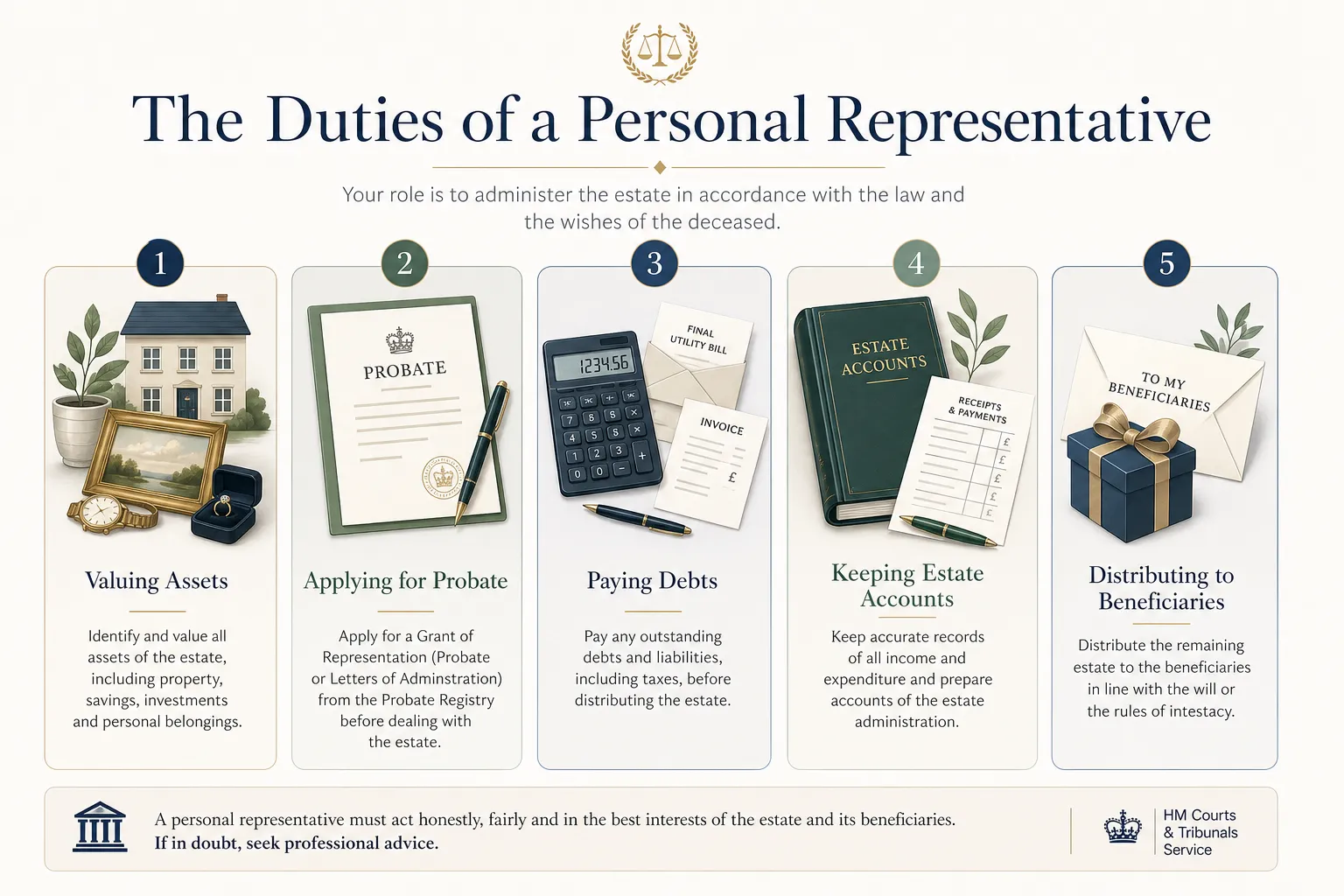
What legal duties do personal representatives owe?
In England and Wales, personal representatives must collect and administer the estate according to law. In practice, that means acting with care, honesty, and reasonable diligence.
Key duties include
acting in the best interests of the estate
treating beneficiaries fairly
not distributing too early
keeping proper records
avoiding conflicts of interest
protecting estate assets
taking appropriate professional advice where needed
If a personal representative gets it wrong, for example by paying beneficiaries before settling liabilities, they may have to put matters right personally.
Common problems personal representatives face
Competitor guidance usually covers the basics, but often glosses over what actually causes stress. In practice, these are some of the most common issues:
Missing information
Important records may be spread across solicitors, filing cabinets, inboxes, phones, and cloud storage.
Digital assets and accounts
Online banking access, subscription services, cloud photos, social media, password managers, and digital business tools are now part of many estates.
Family disputes
Even a straightforward estate can become difficult if expectations differ.
Delays with institutions
Banks, insurers, investment providers, and registries all have their own processes and thresholds.
Tax uncertainty
Inheritance tax reliefs, nil rate bands, and reporting requirements can be more complex than families expect.
A practical checklist for personal representatives
Here is a simple working checklist:
Stage | Practical actions |
|---|---|
Immediate steps | Locate Will, register the event, arrange the funeral, secure property |
Information gathering | List assets, debts, policies, accounts, digital services, advisers |
Valuation | Obtain balances and formal valuations where required |
Grant application | Prepare probate or administration papers |
Administration | Collect assets, pay liabilities, manage property and insurance |
Distribution | Check entitlement, prepare accounts, distribute carefully |
Why secure digital organisation now matters
Estate administration is increasingly a data management exercise as well as a legal one. Sensitive information is often fragmented across multiple systems, which raises both practical and privacy risks.
"The global average cost of a data breach reached $4.88 million in 2024." - IBM
That is a business statistic, but the lesson is broader. Sensitive information needs proper protection, especially when it includes identity documents, account details, personal letters, legal instructions, and family contacts.
"In 2025, 76.9% of EU internet users took steps to protect their personal data online." - Eurostat, January 2026
This is exactly why privacy-first digital estate planning is becoming more relevant. Holdfast stores sensitive estate information in a zero-knowledge encrypted vault, supports documents, credentials, letters, and video messages, and lets users choose precisely which recipient gets access to which item. It is compliant with UK GDPR, which the EU recognises as providing an equivalent level of protection under its adequacy decision — users worldwide are welcome, and data is processed to those standards regardless of where you are based.

How to make life easier for your personal representative
If you are planning ahead, there is a great deal you can do now to reduce the burden on the people who may one day have to act.
Keep these details organised
your Will and solicitor details
property information
bank, savings, and investment summaries
pension and insurance information
key subscriptions and online accounts
funeral wishes
messages or letters for loved ones
a list of professional advisers
Make access controlled, not chaotic
The best planning is not about dumping everything in one folder. It is about organising information so the right person sees the right thing at the right time.
That is where Holdfast is particularly useful. Its setup is simple, maintenance is low, and check-ins can be monthly or flexible. It is suitable for individuals, couples, and professional advisers including UK solicitors and IFAs, as well as their international counterparts. Importantly, it is not only for high-value estates. Photographs, passwords, letters, and practical instructions matter to families regardless of wealth.
Should a personal representative use a solicitor?
Often, yes, especially where the estate includes:
property sales
business interests
foreign assets
inheritance tax issues
trusts
missing beneficiaries
disputes or possible claims
A solicitor can help reduce risk, but the personal representative still remains responsible for the role unless authority is formally transferred in some other lawful way.
Final thoughts
A personal representative has a clear but weighty job, to protect the estate, deal with tax and debts, keep proper records, and ensure the right people receive the right entitlements. The role matters because estate administration is not only about legal formalities, it is about clarity, timing, privacy, and trust.
The smoother this process is, the easier it is for loved ones and advisers to act confidently. Holdfast helps make that possible by giving people a secure, organised way to prepare essential information in advance, with AES-256 client-side encryption, zero-knowledge privacy, and carefully controlled delivery only after multiple missed check-ins. It is compliant with UK GDPR, which the EU recognises as providing an equivalent level of protection under its adequacy decision — users worldwide are welcome, and data is processed to those standards regardless of where you are based. If you want to reduce uncertainty for the people who may one day need to step in, it is a calm and practical place to start.
FAQ
What are five duties of the personal representative?
Five core duties are to identify assets and debts, secure the estate, apply for probate or letters of administration if needed, pay liabilities and tax, and distribute the estate correctly. They must also keep accurate records throughout.
What is the role of a personal representative?
The role of a personal representative is to administer the estate legally and properly. This includes gathering assets, settling debts and taxes, and making sure beneficiaries receive what they are entitled to.
Who is a personal representative and what do they do?
A personal representative is either an executor named in a Will or an administrator appointed where there is no Will or no executor acting. They manage the estate from start to finish and may be personally liable for mistakes.
What is an example of a personal representative?
An example would be a spouse, adult child, friend, or professional adviser who is named as executor in a Will. If there is no valid Will, a close relative may instead apply to act as administrator.
Can a personal representative be held personally liable?
Yes. The role carries legal responsibility. If a personal representative distributes assets before settling debts, mismanages estate funds, or fails to act with reasonable care, they may be personally liable to make good any resulting loss to the estate or beneficiaries.