Estate Without Will: What Families Need to Know
If a loved one leaves behind an estate without a will, families are often left dealing with two problems at once, grief and uncertainty. Who is entitled to what, who can deal with the bank accounts, what happens to the home, and how long will it all take?
In the UK, this situation is called intestacy. It means the estate is distributed according to legal rules, not personal wishes. Those rules can be workable, but they are rarely simple, and they often do not reflect modern family life, blended families, unmarried partners, stepchildren, or the practical need to access passwords, financial records, letters, and instructions quickly.
For many families, the legal position is only part of the challenge. The other part is information. Even where the law is clear, the person sorting everything out may struggle to find account details, insurance papers, solicitor contacts, funeral wishes, property records, or personal messages meant for family.
That is why good preparation matters. A valid will is important, but so is a secure way to organise the information people actually need. Holdfast helps individuals, couples, families, solicitors, and financial advisers store sensitive legacy information safely in an encrypted digital vault, then share it only with the right people, only when needed.
"As of December 2024, the average probate application processing time in the UK was reduced to just over four weeks, down from twelve weeks at the end of 2023." - GOV.UK
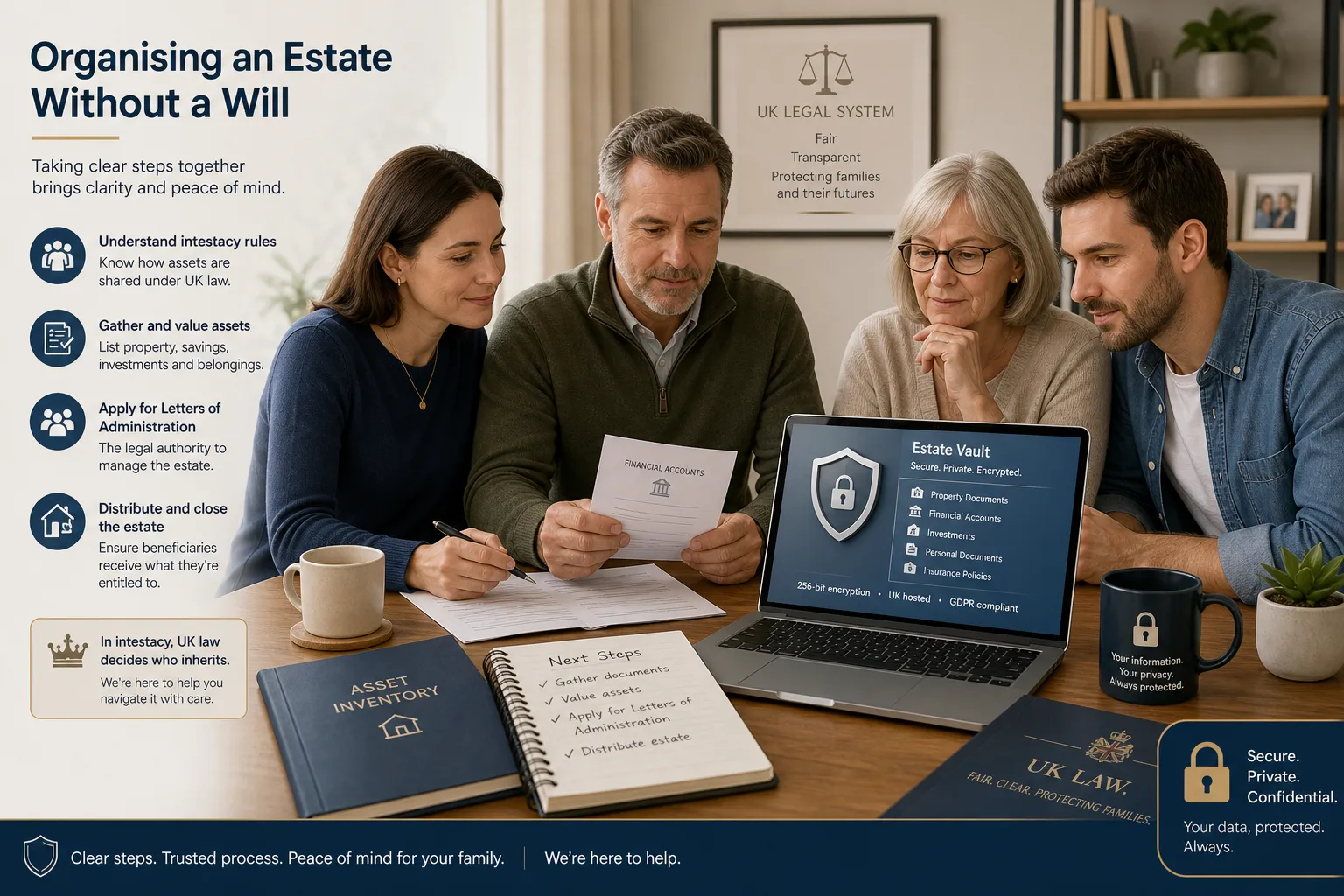
What does an estate without a will mean?
An estate without a will means someone has not left a valid will covering their assets and wishes. In legal terms, they are treated as having died intestate, but for families the practical meaning is straightforward, the law decides who inherits and who can administer the estate.
The estate usually includes:
money in bank and savings accounts
property and land
investments and shares
personal possessions
debts owed to or by the estate
in some cases, digital assets and online accounts
A key point many articles gloss over is this, a will and an estate plan are not the same thing. Even where a will exists, families often still need access to:
account lists
key contacts
insurance details
login instructions
legal paperwork
funeral preferences
letters or personal messages
Without that information, even a simple estate can become stressful.
The intestacy rules in England and Wales, in plain English
If there is no valid will, the estate is shared according to the rules of intestacy. These rules set an order of priority.
Who usually inherits first
In England and Wales, the main categories are:
spouse or civil partner
children
parents
full siblings, then their children
half siblings, then their children
grandparents
aunts and uncles, then their children
half aunts and half uncles, then their children
the Crown, if no eligible relatives are found
Important limits people often misunderstand
The rules do not automatically protect everyone someone may have wanted to include.
Person or relationship | Automatic inheritance under intestacy? |
|---|---|
Husband, wife, civil partner | Yes |
Long-term unmarried partner | No |
Biological child | Yes |
Adopted child | Yes |
Stepchild not legally adopted | No |
Former spouse after divorce | No |
Friend, carer, neighbour | No |
This is one of the biggest pain points for modern families. A long-term partner may have shared a home, finances, and responsibilities for years, yet still have no automatic right to inherit under intestacy rules.
What happens if there is a spouse or civil partner?
In England and Wales, where there is a surviving spouse or civil partner, what they receive depends partly on whether there are children.
If there are no children
The surviving spouse or civil partner usually inherits the whole estate.
If there are children
The surviving spouse or civil partner usually receives:
all personal possessions
the first £322,000 of the estate
half of the remaining estate
The children share the other half of the remainder equally.
This can surprise families, particularly where most wealth is tied up in a house. It can also create practical tension if children from an earlier relationship inherit alongside the current spouse.
What happens if there is no spouse or civil partner?
If there is no surviving spouse or civil partner, the children usually inherit the estate equally.
If a child has already passed away but left children of their own, those grandchildren may inherit their parent's share.
If there are no children, the estate moves down the legal order of priority, parents, siblings, grandparents, wider relatives.
What about jointly owned property and joint bank accounts?
This is where many families get caught out.
Some assets do not pass under the intestacy rules in the normal way. They may pass automatically to the surviving joint owner.
Jointly owned property
Whether a property passes automatically depends on how it was owned:
Type of ownership | What usually happens |
|---|---|
Beneficial joint tenancy | The surviving owner usually receives the deceased owner's share automatically |
Tenancy in common | The deceased owner's share forms part of the estate |
Joint bank accounts
Joint bank accounts usually pass to the surviving account holder automatically, although banks may still need paperwork before releasing or transferring funds.
Why this matters
Families often assume the house or joint savings are part of the intestate estate, when legally they may not be. That changes both the value of the estate and who receives what.
Do stepchildren, unmarried partners, or carers inherit?
Usually not automatically.
This is where intestacy rules can feel harsh.
Unmarried partners
An unmarried partner, even after many years together, does not automatically inherit under the intestacy rules in England and Wales.
Stepchildren
Stepchildren do not automatically inherit unless they were legally adopted.
Carers, close friends, or companions
They do not inherit under intestacy unless they fall within the legal family categories.
In some situations, a person who has been left without reasonable provision may be able to bring a court claim, but that is separate from the normal intestacy process and often requires specialist legal advice.
Who deals with the estate if there is no will?
Where there is no executor named in a will, someone has to apply to become the estate's administrator. In England and Wales, this usually means applying for letters of administration.
The administrator's job is to:
identify assets and debts
value the estate
deal with banks, insurers, and institutions
apply for probate paperwork where required
pay tax and debts
distribute what remains under the intestacy rules
Who can apply first?
Usually the people most entitled to inherit have priority to apply, for example:
spouse or civil partner
children
other close relatives in order of entitlement
If there is disagreement, delay often follows.
Do you always need letters of administration?
Not always.
Some estates are small enough that institutions will release funds without a grant. Some jointly owned assets pass automatically. But if there is property in the sole name of the person who has passed away, or significant financial assets, a grant is commonly needed.
Banks and building societies each have their own thresholds and internal rules. That means one bank may release a small balance without a grant, while another may require formal paperwork.
The real reasons estates without wills become stressful
Most competing articles explain the legal order of inheritance, but miss the operational reality. Families do not struggle only because the law is complicated. They struggle because the information is scattered, private, or missing.
Common friction points
no clear list of accounts or subscriptions
uncertainty over property ownership
lost insurance policies
no record of debts or liabilities
missing pension details
no secure record of passwords or digital assets
confusion over who should contact which institution
emotionally important letters or wishes stored informally, or nowhere at all
This is where a secure digital estate system becomes genuinely useful.
Why digital organisation matters as much as the will itself
A will determines legal distribution. It does not always solve communication.
Families often need access to:
solicitor details
mortgage and lender references
pension provider contacts
utility and subscription accounts
identity documents
account credentials
instructions for pets, property, or business continuity
private letters and video messages
If this information is left in notebooks, email drafts, phone notes, or shared spreadsheets, privacy risks increase sharply.
That is especially important in a world where sensitive personal data is a target.
"The global average cost of a data breach reached $4.88 million in 2024." - IBM
For that reason, storing legacy information in ordinary cloud folders, email inboxes, or shared documents is often not good enough.
How Holdfast helps reduce confusion for families
Holdfast is built for the part traditional estate planning often misses, secure access to the right information by the right person at the right time.
What Holdfast is designed to do
Holdfast allows users to store sensitive personal and estate information in a secure digital vault, including:
financial information
account details and credentials
legal and solicitor details
letters to family
video messages
practical household instructions
key document references
Privacy by design
Holdfast uses client-side AES-256 encryption and a zero-knowledge architecture. In plain English, that means the contents are encrypted before storage, and Holdfast cannot read the plaintext contents of the vault.
This matters because legacy planning is deeply personal. Families need confidence that private records, messages, and credentials are not casually accessible.
Controlled sharing
Not every recipient should see everything. Holdfast lets users organise access so that each recipient only sees what they are meant to see.
For example:
Recipient | What they might receive |
|---|---|
Spouse or partner | household finances, key contacts, property records |
Adult child | selected legal documents, family letters |
Solicitor | limited case documents or instructions |
Financial adviser | relevant financial records only |
Close friend | personal message only |
This kind of controlled disclosure is especially valuable for blended families, business owners, and professional advisers.
Automated delivery, but only after safeguards
Holdfast includes a dead man's switch style check-in system, but with a calm and careful process. Users complete simple periodic check-ins. If multiple check-ins are missed, Holdfast follows an escalation process before any designated information is released.
That reduces the risk of premature disclosure while still helping ensure loved ones are not left searching for essential information.
Low maintenance, not another admin burden
One of the quiet advantages of Holdfast is that it is designed to be easy to set up and easy to keep current. Users can choose monthly or flexible check-ins, and once the structure is in place it becomes a simple routine rather than a large annual project.
Holdfast vs informal estate information storage
Approach | Security | Access control | Practical for families | Privacy |
|---|---|---|---|---|
Notebook at home | Low | Low | Can be lost or found by the wrong person | Low |
Emailing documents to family | Low | Low | Easy, but insecure and hard to update | Low |
Shared cloud folder | Moderate at best | Basic | Can become messy or overexposed | Moderate |
Spreadsheet of passwords | Very low | Low | Common, but risky | Very low |
Holdfast encrypted vault | High | Granular | Designed for legacy access and clarity | High |
What information should be organised in advance?
Even if someone has not yet written a will, they can still make life easier for loved ones by organising key records.
Core practical information
full name, date of birth, address history
passport or driving licence references
National Insurance number
NHS number if relevant
solicitor and accountant details
pension providers
banks, savings, and investment platforms
mortgage and loan information
insurance policies
property ownership documents
business interests
Digital and online information
email accounts
cloud storage accounts
subscription services
important social media accounts
domain names or online businesses
password manager instructions
device access guidance
Personal and family communication
wishes for children or dependants
pet care instructions
household and bill information
letters to loved ones
recorded video messages
location of physical documents and keepsakes
A simple checklist for families facing an estate without a will
If you are already dealing with an estate without a will, start with structure.
First steps
Register the death and obtain certified copies of the certificate
Secure the home, paperwork, and devices
Identify close family members and likely administrators
Check whether there are any later-discovered wills or codicils
Make a list of assets, debts, and regular bills
Contact banks, pension providers, insurers, and mortgage lenders
Confirm how property and accounts were owned
Check whether inheritance tax forms or probate documents are needed
Apply for letters of administration if required
Keep detailed records of every action taken
What not to do
do not distribute money too early
do not assume an unmarried partner inherits automatically
do not rely on memory for account information
do not close or access digital accounts informally without checking terms and legal position
do not ignore tax deadlines
Common myths about estates without wills
"My partner gets everything because we lived together"
Not necessarily. In England and Wales, an unmarried partner does not automatically inherit under intestacy.
"Stepchildren count automatically"
Only if they were legally adopted.
"If there is no will, the government takes everything"
Only if there are no eligible relatives under the rules of intestacy.
"Probate always takes ages"
Not always. Processing times have improved in many cases.
"As of December 2024, the average probate application processing time in the UK was reduced to just over four weeks, down from twelve weeks at the end of 2023." - GOV.UK
That said, family disputes, unclear records, missing information, property issues, and tax complications can still slow matters down considerably.
Why this matters for solicitors, IFAs, and other advisers
Professional advisers know that client preparation is rarely just about legal validity. It is about practical readiness.
A good modern estate planning conversation now includes:
a valid will
powers of attorney where appropriate
clear asset records
secure storage of supporting information
controlled disclosure to the right recipients
privacy and compliance standards
Holdfast is suitable not only for individuals and couples, but also for professional firms that want a secure, manageable way to support clients with digital estate planning.
For firms, that means a platform that supports sensitive information handling while reinforcing trust, privacy, and operational clarity.
Holdfast is compliant with UK GDPR, which the EU recognises as providing an equivalent level of protection under its adequacy decision — users worldwide are welcome, and data is processed to those standards regardless of where you are based.
Pricing and suitability
Holdfast is built to be accessible for different levels of need:
Plan | Best for |
|---|---|
Free | exploring the service and starting basic organisation |
Personal, £5/month or £45/year | individuals organising their own legacy information |
Family, £9/month or £79/year | couples and households who want broader coordination |
Firm, £39/month or £399/year | solicitors, attorneys, IFAs, and advisory practices |
Final thoughts
Most families in the UK have not written a will, and many assume that means they have little worth passing on. Holdfast is not built around that assumption. A digital estate is not about wealth. It is about the passwords that unlock a lifetime of photographs, the letter someone meant to write, the instructions that would have saved a family three months of searching. Those things belong to everyone. The Free tier exists because preparing properly should not require a particular income, and the personal tiers are priced to reflect that. Mortality does not discriminate. Holdfast is designed with the same principle in mind.
An estate without a will creates legal uncertainty, but in practice the hardest part is often informational uncertainty. Families need more than legal rules. They need clarity, access, privacy, and confidence that important records and messages will reach the right people.
A will remains essential. But wills do not hold passwords, explain household systems, organise financial references, or deliver personal messages securely. That is where Holdfast adds real value.
With AES-256 client-side encryption, zero-knowledge architecture, controlled sharing, and a carefully managed check-in system that only triggers release after multiple missed check-ins, Holdfast gives users and their loved ones something very simple and very powerful, peace of mind. It is compliant with UK GDPR, which the EU recognises as providing an equivalent level of protection under its adequacy decision — users worldwide are welcome, and data is processed to those standards regardless of where you are based.
If you want to reduce stress for your family, protect sensitive information properly, and organise your digital legacy in a way that is secure, calm, and practical, Holdfast is a strong place to start.
FAQ
What happens to a person's estate if they have no will?
If someone leaves an estate without a will, their assets are distributed according to the rules of intestacy. In England and Wales, this usually means a spouse or civil partner, children, and then other close relatives inherit in a set legal order, rather than according to personal wishes.
What is the 2 year rule after death?
The 2 year rule usually refers to the period in which eligible beneficiaries can agree to change how an estate is shared using a deed of variation or family arrangement. This can sometimes help families redirect assets in a more suitable way, but legal advice is sensible before doing so.
Do you always need letters of administration if someone dies intestate?
No, not always. Some small estates and some jointly owned assets can be dealt with without a grant, but if there is property in a sole name or significant assets, letters of administration are often required before banks or other institutions will release funds.
What happens to money in the bank when someone dies without a will?
Money in a sole account is usually frozen until the bank is satisfied it can release it to the right administrator or beneficiary. A joint account will often pass to the surviving account holder automatically, although the bank may still require documents before completing the process.