Estate planning can feel heavier than almost any other life admin task. It asks you to think clearly about family, finances, legal documents, personal wishes, and increasingly, the digital information that now shapes everyday life. If you have ever wondered where to start, what the estate planning process steps actually are, or how to make sure loved ones are not left searching for accounts, paperwork, passwords, and instructions, this guide is for you.
The good news is that the estate planning process does not need to be dramatic or overwhelming. At its core, it is about creating clarity. You are organising what matters, deciding who should act on your behalf, documenting your wishes, and making sure the right people can access the right information at the right time.
For many people, one major gap in traditional planning is digital life. Wills, powers of attorney, and tax planning are essential, but so are email accounts, subscription services, cloud storage, banking logins, solicitor details, letters to family, and practical instructions. That is where modern digital estate tools such as Holdfast can add real peace of mind. Holdfast helps individuals, couples, families, and professional advisers securely store sensitive estate information in an encrypted digital vault, with client-side AES-256 encryption, zero-knowledge architecture, controlled sharing, and automated delivery only after multiple missed check-ins.
"43% of UK businesses and 30% of charities experienced cyber attacks or breaches in the last year." - UK Cyber Security Breaches Survey 2025
"UK adults spend an average of four and a half hours online daily, primarily using smartphones with an average of 41 apps per month." - Ofcom Online Nation 2025
Those two facts point to an important truth. Estate planning is no longer just about paper files in a drawer. It is also about protecting and passing on access to a growing digital life, securely and privately.
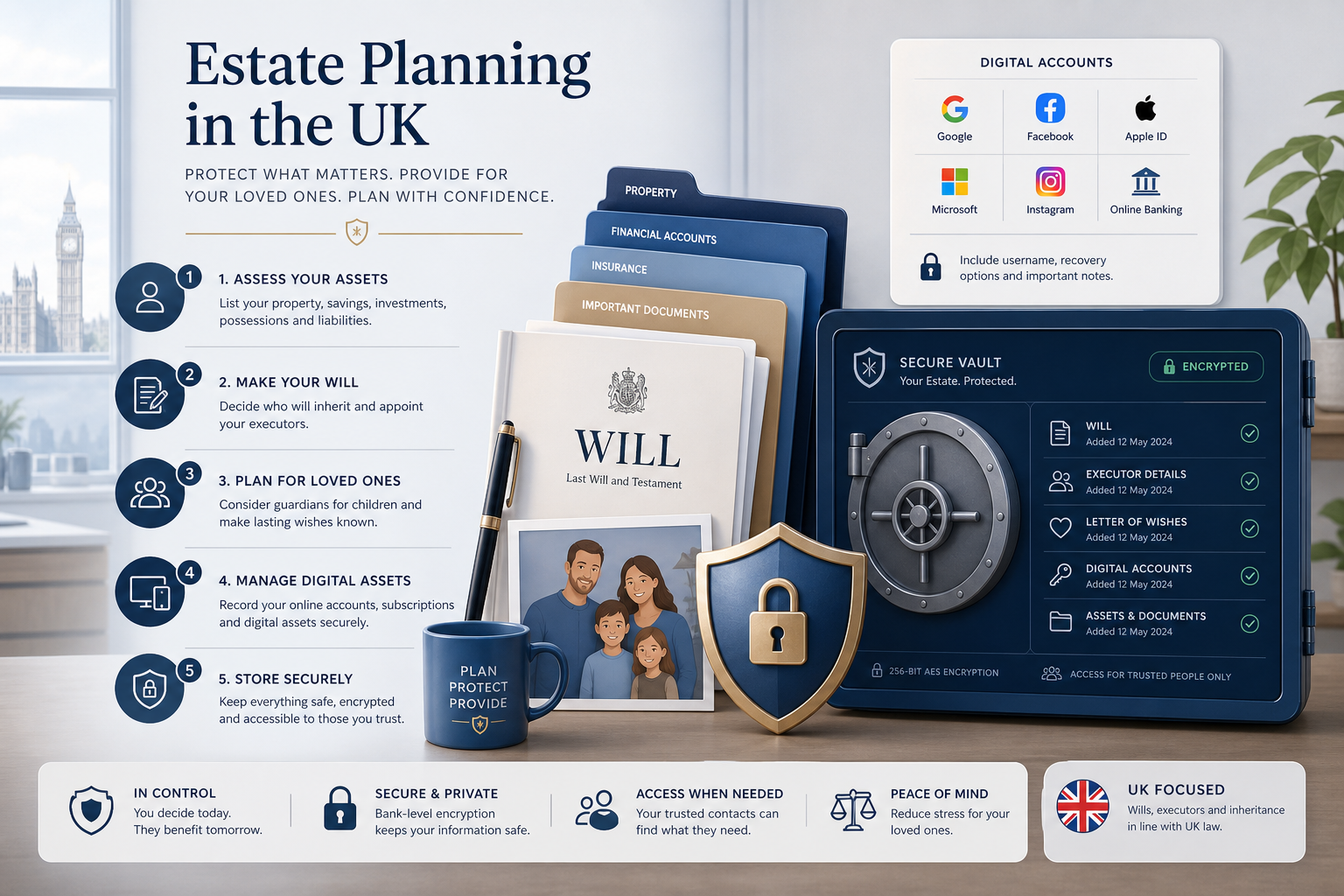
What Is the Estate Planning Process?
The estate planning process is the structured way you organise your assets, responsibilities, legal documents, personal wishes, and key information so that trusted people can act confidently if you are no longer able to explain everything yourself.
A strong plan usually covers:
What you own
Who should benefit
Who should make decisions if needed
How children or dependants should be protected
Whether trusts are appropriate
What tax issues may arise
Where important information is stored
How digital accounts, records, and messages should be handled
Many articles reduce this to only wills and inheritances. In practice, a modern plan is broader. It includes legal planning, practical planning, family communication, and digital access planning.
Why These Estate Planning Process Steps Matter
When people delay planning, it is rarely because they do not care. Usually, they are busy, unsure where to begin, or assume they will sort it later. The risk is not just legal complexity. It is confusion for the people you trust most.
A clear estate plan can help:
reduce uncertainty for partners and family
make professional advice easier and more efficient
support smoother access to essential records
lower the chance of disputes or overlooked assets
protect sensitive information
preserve personal messages, wishes, and instructions
create peace of mind now, not just in the future
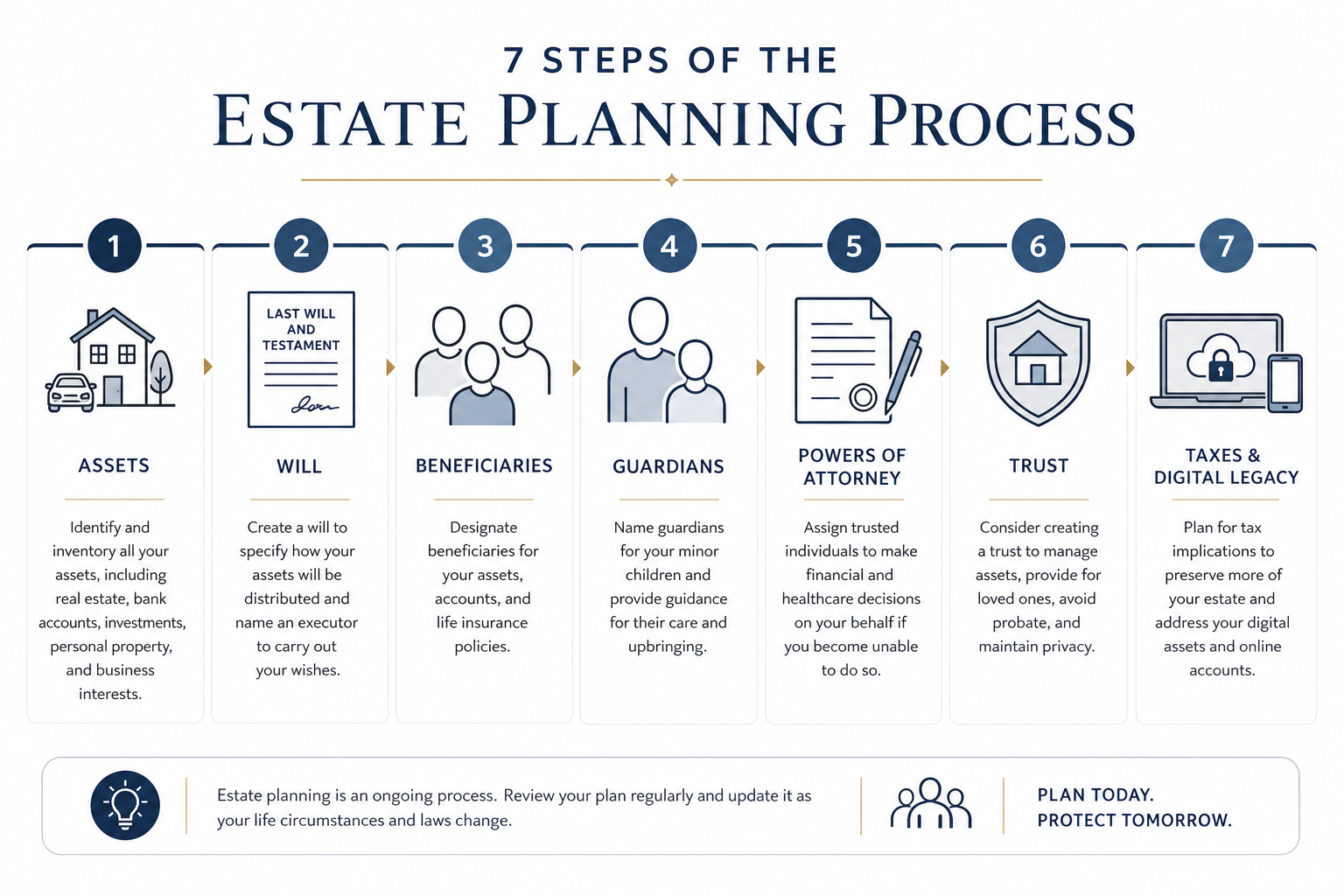
The 7 Estate Planning Process Steps
1. Take Stock of What You Have
Before you can plan properly, you need a clear picture of your estate.
This includes more than property and savings. It can cover:
current accounts and savings accounts
investment portfolios
pensions
life cover
business interests
vehicles
jewellery, art, and valuables
debts and liabilities
property held individually or jointly
digital assets and online accounts
subscription services
cloud storage
crypto holdings, if any
solicitor, accountant, or adviser details
This first stage often reveals two things. First, most people have more moving parts than they realised. Second, key information is often scattered across inboxes, apps, drawers, and different devices.
That is why creating a single secure reference point matters. Holdfast is particularly useful here because it allows users to organise documents, credentials, letters, videos, legal details, and account information in one place, without giving up privacy. Its zero-knowledge design means even Holdfast cannot read the plaintext contents of your vault.
2. Decide Who Should Benefit, and What They Should Receive
The next step is deciding who you want to benefit from your estate and what that should look like.
This usually includes:
a spouse or partner
children or stepchildren
wider family
close friends
charities
dependants
business partners in some cases
This is not only about percentages. It is also about practicality and fairness. For example:
Should certain personal items go to specific people?
Should someone receive information, but not financial control?
Should children inherit at a particular age?
Are there vulnerable beneficiaries who may need extra structure or support?
Are there digital accounts or personal messages meant only for one person?
This is one of the biggest gaps in traditional estate planning content. Physical assets are often discussed, but not selective information sharing. In reality, not everyone should see everything. One recipient may need legal documents. Another may need account instructions. Another may receive a personal letter or video message.
Holdfast addresses this especially well. You can assign specific vault contents to specific recipients, so each person only sees what they are meant to see. That controlled sharing model is far safer and calmer than leaving behind a single master password list or unsecured spreadsheet.
3. Put the Core Legal Documents in Place
For most people, this is the point where professional legal advice becomes essential.
The exact documents depend on your circumstances and jurisdiction, but commonly include:
Document | What it does | Why it matters |
|---|---|---|
Will | Sets out how your estate should be distributed | Provides legal clarity and appoints the right people |
Lasting Power of Attorney or equivalent | Lets trusted people make decisions if capacity is lost | Helps avoid delays and uncertainty |
Advance decision or healthcare directive | Records medical preferences where applicable | Supports dignity and clear decision-making |
Trust documents | Set out how assets are managed within a trust structure | Useful for control, protection, and certain family situations |
Letter of wishes | Adds personal guidance alongside legal documents | Offers context that formal paperwork may not capture |
A will remains foundational, but it is not enough on its own. Many important assets pass outside the will, and many practical tasks require more than legal wording. Loved ones may still need account access, contact details, recurring payment information, or instructions on where key records are stored.
That is why legal planning and digital organisation should work together, not separately.
4. Choose the Right People for Key Roles
Estate plans only work well when the right people are in the right roles.
You may need to appoint:
an executor or personal representative
attorneys under a lasting power of attorney
guardians for children
trustees
professional advisers
digital recipients or digital helpers
The most important qualities are usually trustworthiness, reliability, attention to detail, and willingness to act. Geography can matter too, especially for health and welfare decisions or urgent practical tasks.
Ask yourself:
Does this person understand my wishes?
Are they organised enough to handle responsibility?
Will they communicate well with others involved?
Do they have the emotional steadiness for the role?
Have I actually asked whether they are comfortable doing it?
For many families, a blended approach works best. A trusted relative might act in one role, while a solicitor, financial adviser, or trustee supports the more technical side.
Professional advisers also increasingly recommend digital estate tools because they help clients keep practical information current between formal legal reviews. Holdfast’s Firm plan is designed for this wider professional audience, including UK solicitors, IFAs, and their international legal and financial counterparts who want a secure, privacy-focused system they can recommend or manage for clients.
5. Plan for Children, Dependants, and Complex Family Needs
If you have children, dependants, or vulnerable beneficiaries, your estate plan needs to go beyond broad statements.
Important questions include:
Who would care for minor children?
Who would manage money for them?
At what age should they receive assets directly?
Are there special educational, medical, or care needs?
Should funds be protected through a trust?
How should family businesses or property be handled in a blended family situation?
This part of the estate planning process is often where generic advice stops being useful. Real families are rarely simple. If there are second marriages, international assets, estranged relatives, business ownership, or a child who may need ongoing support, specialist advice is worth it.
There is also a softer side to this step. Some of the most valuable things you can leave are not legal instruments, but guidance, explanation, and reassurance. A secure digital vault can store letters, family notes, practical instructions, and video messages alongside formal documents. That combination can be deeply helpful for recipients.
6. Review Tax, Trust, and Asset Protection Issues
Estate planning is not just about deciding who gets what. It is also about understanding whether the structure of your estate is efficient and resilient.
Depending on your circumstances, this could involve:
inheritance tax planning
use of allowances and exemptions
lifetime gifting strategies
pension nomination reviews
business relief considerations
trust planning
property ownership structure
planning for overseas assets
creditor protection in some cases
Because tax rules vary and change, this is an area where tailored advice matters. The right answer for one family can be the wrong answer for another.
A useful principle is this: keep the strategy as simple as possible, but not simpler than your circumstances require.
Traditional articles often mention gifts and trusts in passing, but gloss over the operational reality that families still need access to supporting records. If you make gifts, create trusts, update nominations, or work with advisers, document what has been done and where those records live. Holdfast can act as the secure operational layer that supports the legal and financial strategy, helping keep adviser details, trust notes, account references, and supporting documents organised in one encrypted place.
7. Organise Secure Storage, Sharing, and Regular Reviews
This final step is where good intentions become a working system.
You now need to make sure:
documents are stored safely
trusted people know what exists
sensitive information is not overexposed
digital instructions are up to date
the plan is reviewed after major life events
your estate plan stays usable, not forgotten
This is the most overlooked stage in competitor content, yet it is where many plans fail. A signed will is important, but it does not solve the practical problem of who can find the right information, when they need it, without compromising your privacy beforehand.
Why secure digital storage matters
A notebook, spreadsheet, or unencrypted password file may feel convenient, but it creates obvious risk. Sensitive estate information can include identity details, bank records, legal instructions, family communications, and credentials. It deserves stronger protection.
Holdfast is built around that exact need. Its approach includes:
client-side AES-256 encryption
zero-knowledge architecture
controlled sharing, so recipients only receive the items intended for them
automated delivery triggered only after multiple missed check-ins
simple setup with low ongoing maintenance
support for documents, credentials, letters, and video messages
compliant with UK GDPR, which the EU recognises as providing an equivalent level of protection under its adequacy decision — users worldwide are welcome, and data is processed to those standards regardless of where you are based
ICO registration
plans suitable for individuals, couples, families, and professional advisers
This matters because estate planning is not only about legal validity. It is also about the recipient experience. The calmer and more organised that experience is, the more effective your planning has been.
A Simple Estate Planning Process Checklist
If you want a practical starting point, use this checklist:
Step | Action | Status |
|---|---|---|
1 | List your assets, liabilities, and digital accounts | ☐ |
2 | Decide who should benefit and what they should receive | ☐ |
3 | Create or update your will and related legal documents | ☐ |
4 | Choose executors, attorneys, guardians, and trustees | ☐ |
5 | Plan for children, dependants, and special family circumstances | ☐ |
6 | Review tax, trust, pension, and asset protection issues | ☐ |
7 | Store everything securely and schedule regular reviews | ☐ |
Common Mistakes People Make During the Estate Planning Process
Even well-intentioned people can miss important details. Common problems include:
Treating estate planning as a one-off task
Plans need review after marriage, separation, children, house moves, business changes, major asset changes, or changes in health.
Focusing only on the will
A will matters, but so do powers of attorney, nominations, secure document storage, and digital account access.
Choosing people without asking them
It is better to have an honest conversation now than a surprise later.
Keeping vital information in insecure formats
Spreadsheets, email drafts, and paper notes can expose too much or go missing.
Forgetting the digital estate
Online banking, email, cloud drives, subscription services, online marketplaces, insurance portals, and personal archives are often central to modern life.
Not separating access by recipient
Different people need different information. Over-sharing can be risky and unnecessary.
Estate Planning for the Digital Age
A modern estate includes more than money and property. It includes digital identity, communication, records, memories, and access.
Your digital estate might include:
email accounts
banking apps
investment platforms
cryptocurrency wallets
tax records
utility accounts
cloud storage
social media profiles
domain names
subscription services
family photos and videos
personal letters
scanned legal documents
adviser contact details
insurance logins
business software and admin tools
Traditional estate planning often leaves these in a grey area. The practical need is clear, but the storage method is weak. That is why privacy-first legal technology is becoming more important.
Holdfast solves a real operational problem. It gives you a secure digital vault for the information your loved ones may genuinely need, while keeping everything encrypted, segmented, and released only under carefully controlled conditions. The monthly or flexible check-in system keeps the process low maintenance, and the automated escalation only proceeds after multiple missed check-ins.
Holdfast vs Traditional DIY Storage Methods
Feature | Paper folder | Spreadsheet or notes app | Password manager alone | Holdfast |
|---|---|---|---|---|
Stores documents | Yes | Sometimes | Limited | Yes |
Stores personal letters and videos | Limited | Sometimes | No | Yes |
Granular recipient sharing | No | No | Limited | Yes |
Client-side encryption | No | Usually no | Varies | Yes |
Zero-knowledge architecture | No | No | Varies | Yes |
Automated delivery after missed check-ins | No | No | No | Yes |
Designed for estate communication | No | No | No | Yes |
Suitable for advisers and clients | Limited | No | Limited | Yes |
Who Should Start the Estate Planning Process Now?
You do not need to wait for retirement, wealth complexity, or a major life event to begin.
This is worth doing now if you are:
in a long-term relationship
a parent
a homeowner
self-employed or a business owner
responsible for ageing relatives
supporting a vulnerable dependant
privacy-conscious about personal information
already working with a solicitor or financial adviser
carrying a growing number of digital accounts
keen to spare family unnecessary confusion later
In practice, the best time to start is before urgency appears.
How Holdfast Fits Into a Complete Estate Plan
Holdfast is not a substitute for legal advice. It is the secure infrastructure that makes a broader estate plan easier to organise, maintain, and use.
It works particularly well alongside:
wills and trust planning
powers of attorney
solicitor and adviser relationships
family preparedness conversations
digital legacy planning
secure document storage
selective sharing of practical instructions and personal messages
For many users, the real value is peace of mind. You know that the important details are not scattered, not overexposed, and not dependent on someone finding the right notebook at the right time.
Holdfast plans
Public plans include:
Free
Personal, £5/month or £45/year
Family, £9/month or £79/year
Firm, £39/month or £399/year
That makes it accessible for individuals starting out, couples organising jointly, families who need shared structure, and professionals supporting multiple clients.
Final Thoughts
The estate planning process is not really about paperwork for its own sake. It is about reducing uncertainty and protecting the people who may one day need clarity from you most.
The seven estate planning process steps are simple to understand, even if your personal circumstances are complex:
understand what you have
decide who should benefit
put legal documents in place
appoint the right people
protect children and dependants
review tax and trust issues
store, share, and review everything securely
If you want your plan to work in real life, not just in theory, digital organisation matters as much as legal drafting. That is where Holdfast stands out. With client-side AES-256 encryption, zero-knowledge architecture, controlled sharing, automated delivery only after multiple missed check-ins, and a calm user experience, it offers a modern and privacy-first way to protect your legacy. It is compliant with UK GDPR, which the EU recognises as providing an equivalent level of protection under its adequacy decision — users worldwide are welcome, and data is processed to those standards regardless of where you are based.
If you are ready to move from vague intention to organised peace of mind, Holdfast is a smart next step.
FAQ
What are the 7 steps in the planning process?
The seven key steps are to review your assets, decide who should benefit, put core legal documents in place, choose the right people for key roles, plan for children or dependants, review tax and trust issues, and store everything securely while keeping it up to date. Together, these steps create a practical and legally informed estate plan.
What are the 7 steps of financial planning in order?
Financial planning and estate planning overlap, but they are not identical. In estate planning order, it usually makes sense to identify assets and liabilities first, then name beneficiaries, document legal wishes, appoint decision-makers, consider dependants, review tax efficiency, and organise secure storage and regular reviews.
What should a digital estate plan include?
In this context, the planning process means creating a clear framework for your estate and digital legacy. The seven steps are inventory, beneficiaries, legal documents, trusted appointments, dependant planning, tax and trust review, and secure ongoing management, including safe digital storage and controlled sharing.