Modern family life now runs through screens, apps, cloud accounts, shared subscriptions, online banking, password managers, photos, videos, and digital paperwork. Yet many estate plans still focus mainly on property, savings, and physical documents. That leaves a quiet but serious gap. When a partner, child, parent, or trusted adviser needs access to essential information, the practical problem is often not ownership, it is access.
Digital asset planning solves that problem. It helps families organise what exists, decide what should happen to it, and make sure the right people can access the right information at the right time, without exposing everything to unnecessary risk.
For UK households, this is becoming more important, not less. The Property (Digital Assets etc) Act 2025 has strengthened the legal recognition of digital assets as property in the right contexts, but legal recognition alone does not make passwords retrievable, cloud storage discoverable, or platform rules easier to navigate. Families still need a practical system.
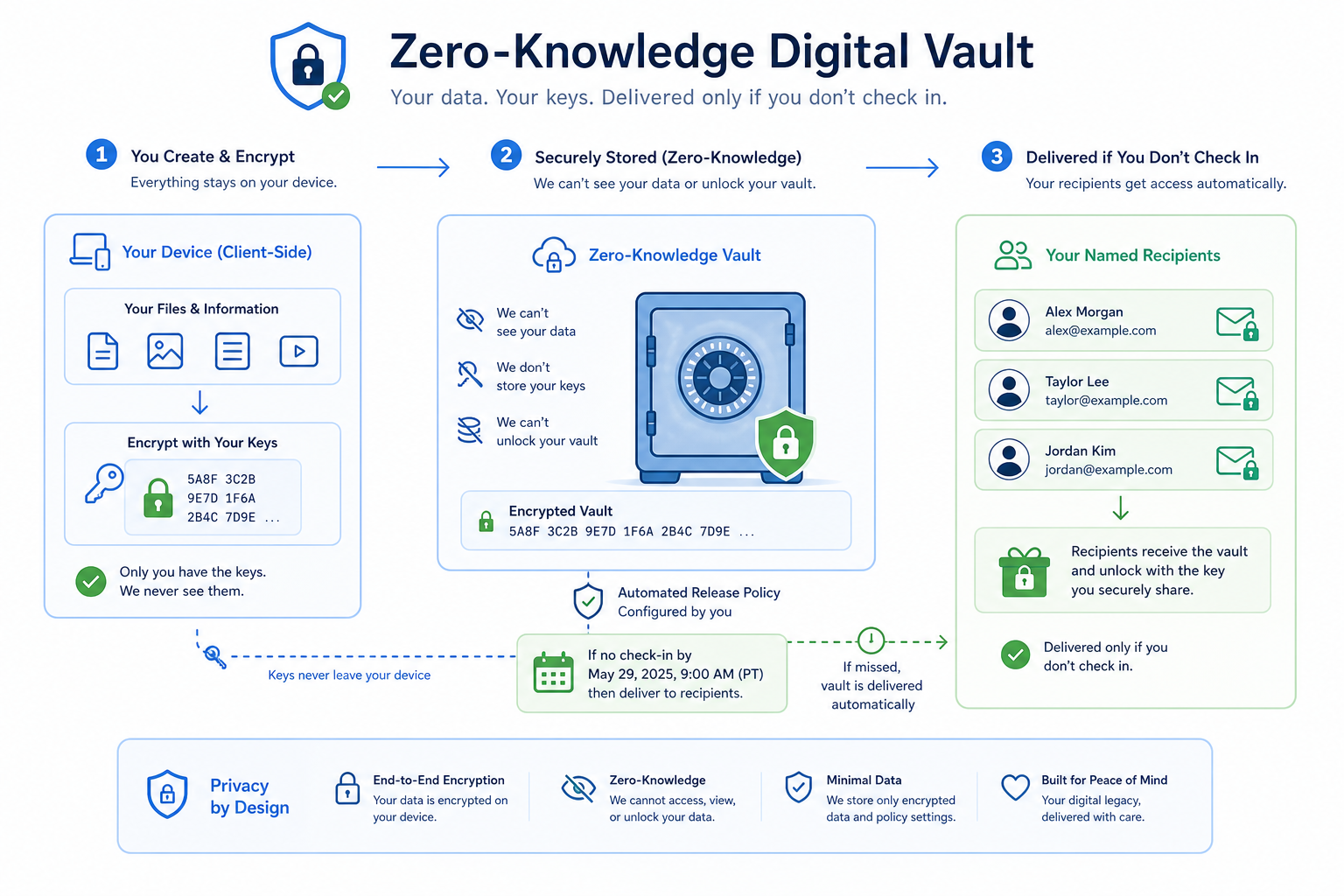
Holdfast was built for exactly this challenge. It is a zero-knowledge digital estate vault with a dead man's switch. Vault contents are encrypted client-side using AES-256, only the intended recipients receive the items assigned to them, and automated delivery only happens after multiple missed check-ins and an escalation process. That means sensitive information stays private while you are managing it, and accessible when your loved ones or professional advisers genuinely need it.
"In the UK, 75% of respondents acknowledged reusing credentials at least some of the time." - IBM
"The global average cost of a data breach is $4.4 million." - IBM
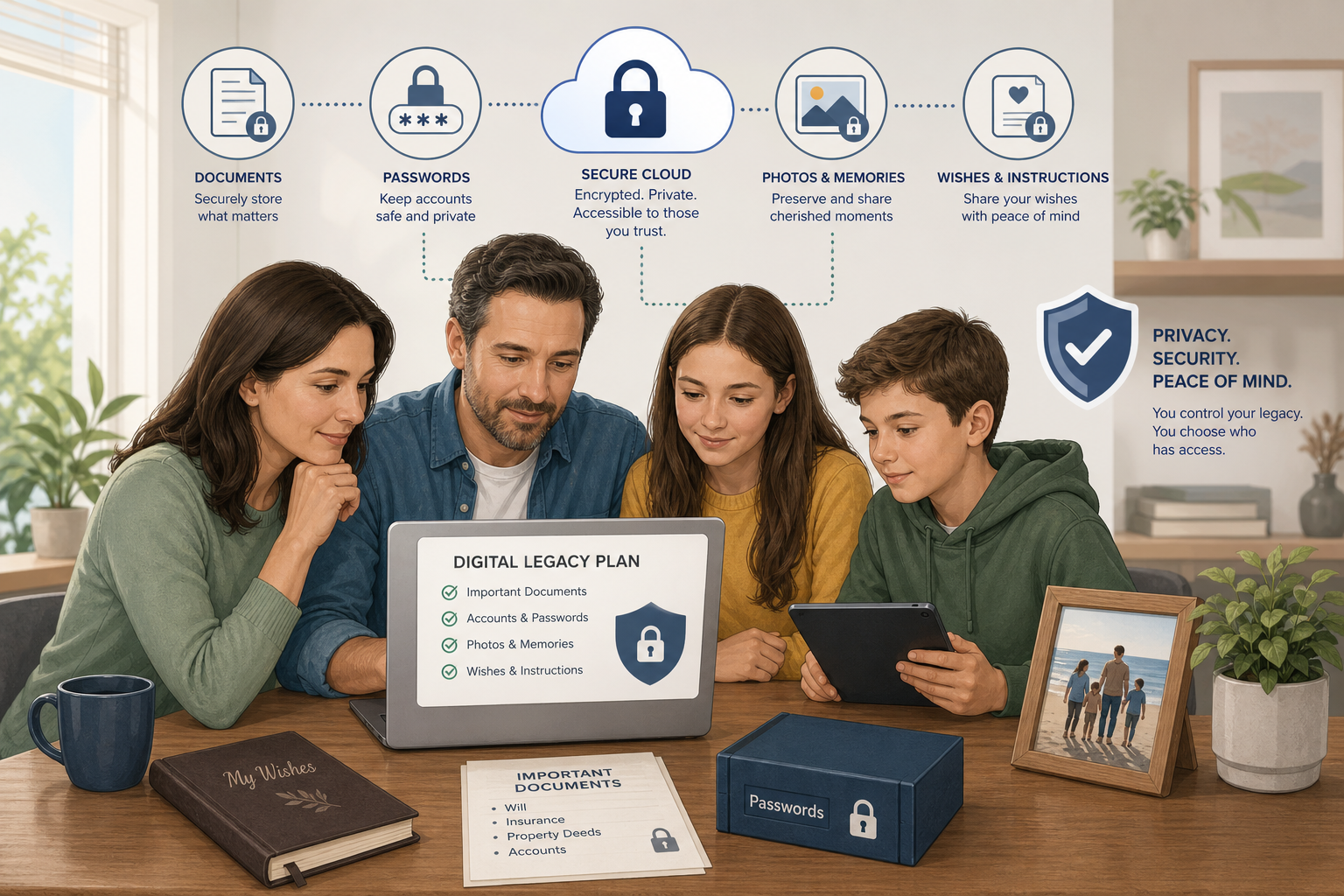
Why digital asset planning matters now
Most people already know they should have a will. Fewer realise they also need a map of their digital life.
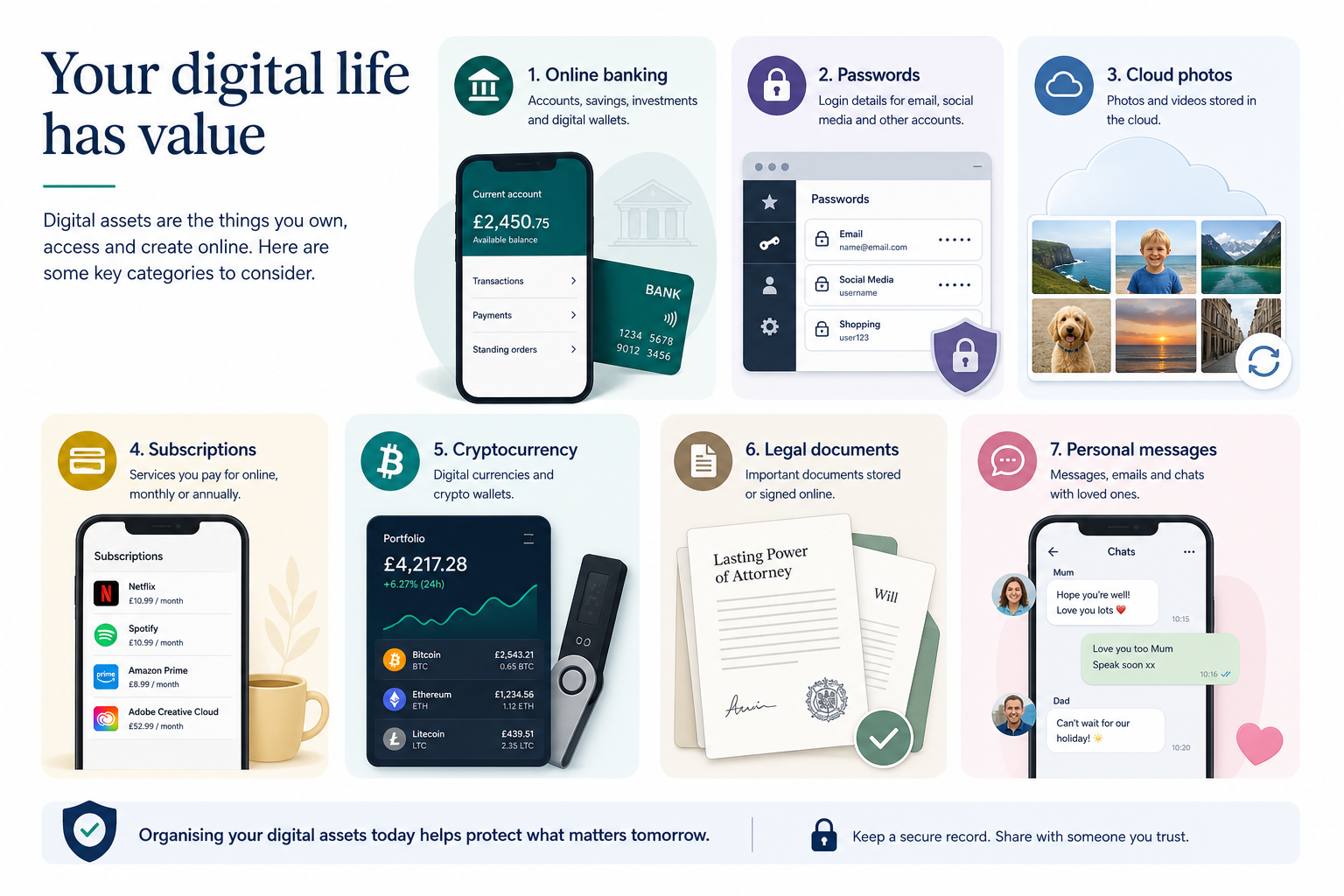
That digital life often includes:
online current and savings accounts
investment platforms
payment apps
cryptocurrency and wallet recovery details
shared family photo libraries
email accounts
cloud storage
mobile contracts and utilities
subscription services
online shopping accounts
social media profiles
business tools and domain names
passwords, passkeys, and two-factor recovery methods
letters, wishes, and private messages intended for loved ones
If these are not organised in advance, the result is rarely smooth. Families can spend weeks or months trying to identify what exists, who should handle it, and whether access is even possible. In emotional situations, that uncertainty becomes a burden.
This is why digital legacy planning is not only about wealth. It is also about clarity, privacy, and reducing stress for the people left to manage practical tasks.
What counts as a digital asset
A digital asset is any digitally stored account, record, credential, file, subscription, or item of value, whether financial, practical, or sentimental.
Financial digital assets
These are the most obvious and often the most urgent:
online banking access
investment platforms
pension portals
crypto exchanges and wallets
online payment services
reward balances and valuable digital holdings
Administrative digital assets
These keep daily life running:
email accounts
mobile and broadband accounts
online council tax or utility logins
insurance portals
cloud document storage
password managers
identity verification apps
subscription services
Personal and sentimental digital assets
These are often overlooked, despite having deep value to families:
family photos and videos in cloud storage
voice notes and personal recordings
private letters and messages
social media profiles
memorial pages or personal websites
digital journals and creative work
Business and professional digital assets
For business owners, freelancers, and advisers, the list can extend further:
domain names
company social channels
website hosting logins
invoicing platforms
client records
secure notes
software licences
The legal picture in the UK
Digital asset planning sits at the intersection of estate administration, privacy, contract law, platform rules, and practical access control.
The Property (Digital Assets etc) Act 2025
The Property (Digital Assets etc) Act 2025 is important because it helps confirm that certain digital assets can be recognised as property. That matters for succession, probate, and estate administration.
However, legal recognition is only part of the picture.
A digital asset may be capable of passing through an estate, but that does not mean:
relatives know it exists
executors can find it
passwords or recovery methods are available
platform terms allow transfer
important instructions are documented clearly
The law helps answer whether something can form part of an estate. Good planning answers how anyone will actually locate and manage it.
Probate, executors, and Letters of Administration
In the UK, digital assets may need to be handled by:
executors named in a will
administrators acting under Letters of Administration where there is no valid will
attorneys acting under a Lasting Power of Attorney for property and financial affairs during incapacity, if appropriate
That means your digital planning should not sit in isolation. It should support the wider legal framework that applies to your affairs.
Platform terms still matter
Even where the law recognises digital assets, individual platforms set their own terms for:
memorialisation
account closure
transfer restrictions
access by authorised persons
download rights
inactivity handling
Apple, Google, Meta, LinkedIn, crypto exchanges, and subscription services all have different rules. Some allow designated legacy contacts or inactivity settings. Others permit deactivation but not transfer. Some content is licensed, not owned, which changes what can be passed on.
This is one of the biggest content gaps in many articles on the subject. They explain that digital assets matter, but not that access often depends on a mix of legal authority, technical preparation, and platform-specific settings.
The real risks of poor preparation
Poor digital planning creates more than inconvenience.
1. Important assets are missed
If nobody knows an account exists, it may never be identified. That includes dormant investment accounts, crypto holdings, premium subscriptions, cloud archives, or income-generating digital property.
2. Password inheritance becomes chaotic
Many families still rely on handwritten lists, spreadsheets, shared notes apps, or ad hoc messages. These approaches are fragile, insecure, and difficult to keep current.
3. Sensitive information is overshared
A common mistake is giving one person access to everything. In practice, that is rarely appropriate. Your partner may need household financial information, your solicitor may need legal documents, and your children may only need personal letters or photo access.
4. Sentimental content is lost
Family photos, voice notes, message archives, and private reflections often matter more than money, yet they are frequently left trapped inside phones or cloud accounts.
5. Cybersecurity risks increase
Scattered credentials, password reuse, and unsecured storage methods expose families to fraud precisely when they are least prepared to manage it.
6. Professional advisers face delays
Solicitors, IFAs, accountants, and international legal or financial counterparts can only work efficiently if core information is available and organised. Missing logins, undocumented accounts, and unclear wishes slow everything down.
Why traditional estate planning is not enough on its own
A will is essential, but it is not designed to function as a live operating manual for your digital life.
A will is not a password vault
Including passwords directly in a will is usually a poor idea. Wills become part of the administration process and may be copied, stored, or handled by multiple parties. Passwords also change often, which makes a static legal document impractical.
A will cannot keep pace with digital change
You might open new accounts, change two-factor authentication, move photos to new services, sell crypto, or update recipients. A digital plan needs to be easy to maintain.
Not every recipient should see everything
Traditional estate documentation does not always provide the granularity families need. Digital planning often requires item-by-item sharing rules.
The modern family challenge, ownership versus access
This is the core issue most families face.
You may have every intention of sharing important details with the right people, but when the moment comes, you may no longer be in a position to hand over credentials, explain what matters, or clarify what should happen next.
That is the access problem.
The best digital estate systems solve it by answering five practical questions:
Question | Why it matters |
|---|---|
What exists? | Families and advisers cannot manage what they cannot find |
Where is it? | Cloud, app, device, paper records, password manager, exchange, solicitor |
Who should receive it? | Different people need different information |
When should they receive it? | Immediately, only after escalation, or only if needed |
How will it be delivered securely? | Loose documents and shared notes are not enough |
How Holdfast solves the access problem
Holdfast is designed around privacy, practical delivery, and peace of mind.
Zero-knowledge digital estate vault
Holdfast stores sensitive digital estate information in a zero-knowledge vault. That means the contents are encrypted client-side using AES-256 before storage, so Holdfast cannot read the plaintext contents.
This is especially important for:
credentials
financial details
legal information
private letters
family instructions
video messages
personal records
Controlled sharing by recipient
Not every person needs the same information. Holdfast lets you assign specific items to specific recipients, so each person only sees what they are meant to see.
For example:
a spouse can receive household account instructions
an adult child can receive family photo archive guidance
a solicitor can receive legal contacts and document notes
an IFA can receive relevant financial summaries
a close friend can receive a personal letter or video message
Automated delivery after multiple missed check-ins
Holdfast includes a dead man's switch mechanism. Users complete simple periodic check-ins. If multiple check-ins are missed, Holdfast follows an escalation process before releasing the designated vault contents to nominated recipients.
This matters because the problem is rarely storage alone. It is timing. The information must remain private unless and until it is genuinely needed.
No recipient account required in advance
Recipients do not need a Holdfast account before information is sent. That removes friction and makes planning more realistic for families who are not all equally technical.
Calm, low-maintenance setup
Once configured, the system is simple to maintain. You can update records over time, choose monthly or flexible check-ins, and keep the process light-touch rather than burdensome.
What to include in a strong digital asset plan
A complete plan should be practical, current, and easy for the right people to use.
Core account inventory
Start with a structured list of:
financial platforms
email accounts
cloud storage providers
telecoms and utilities
insurance portals
subscriptions
social media accounts
shopping accounts
crypto holdings
websites and domain names
Credential and recovery planning
You do not necessarily want passwords inside a paper document. But you do need a secure route to access.
Include:
account names and purpose
login identifiers
where credentials are stored
recovery email or phone details
two-factor authentication notes
device dependencies
backup code location
Wishes and handling instructions
For each account or category, decide:
who should access it
whether it should be closed, archived, memorialised, or maintained
whether content should be downloaded
whether any messages or files should be passed to family
whether a professional adviser should be involved
Legal and professional contact details
Include:
solicitor details
will storage details
LPA information
accountant details
IFA or wealth adviser details
business continuity contacts where relevant
Personal letters and messages
A digital plan should not be purely administrative. It can also carry the human side of legacy planning, including:
personal letters
instructions for family milestones
private recordings
video messages
practical notes that reduce stress for loved ones
A practical framework for families
The easiest way to organise a digital estate is to divide it into four layers.
Layer 1, Essential access
These are the items your closest recipient may need quickly:
primary email
mobile account
banking overview
password manager instructions
device unlock guidance
solicitor and adviser contacts
Layer 2, Estate administration support
These help executors or administrators do their work:
asset inventory
account list
document locations
subscriptions to cancel
digital business interests
crypto instructions
tax-related records
Layer 3, Family continuity
These help the household keep functioning:
bills and utilities
household service logins
insurance details
child-related subscriptions or services
shared calendars and file storage
Layer 4, Personal legacy
These preserve meaning, not just logistics:
photos and videos
letters
life notes
values statements
guidance for sentimental digital possessions
Common mistakes to avoid
Relying on memory
Even organised people forget accounts over time.
Storing everything in one unencrypted document
This creates a single point of failure.
Sharing all credentials with one person
This creates privacy, security, and relationship problems.
Ignoring two-factor authentication
Passwords alone are often not enough.
Forgetting platform-specific settings
Legacy contacts, inactivity managers, and memorialisation settings should align with your plan.
Failing to update after life changes
Marriage, separation, children, relocation, new accounts, adviser changes, and business changes all affect digital planning.
Digital asset planning for couples
Couples often assume they already share enough information. In practice, they usually share fragments.
A better approach is to separate:
jointly managed household information
individually private information
legally relevant information
sentimental content intended for later delivery
Holdfast is particularly well suited to couples because it supports controlled sharing without forcing total transparency. One partner can make sure the other receives what is needed, without exposing every private note, account, or message while everything is operating normally.
Digital asset planning for parents and adult children
Parents may want to ensure adult children can help with practical administration, but only in limited ways.
Examples include:
giving one child access to document locations
giving another access to family photos
reserving financial summaries for the executor or adviser
sharing personal messages separately from financial instructions
This avoids both confusion and oversharing.
International families and cross-border considerations
Many families now live internationally, hold accounts across jurisdictions, or use global digital platforms. This makes digital planning more important.
Cross-border complexity can involve:
assets in multiple currencies
global cloud services
international beneficiaries
different privacy rules
varied succession procedures
local platform restrictions
Holdfast is built in the UK and used worldwide. It is compliant with UK GDPR, which the EU recognises as providing an equivalent level of protection - users worldwide are welcome, and data is processed to those standards regardless of where you are based.
That combination of UK data standards and international usability makes it a strong fit for globally connected families and internationally active advisers.
A better security model for digital inheritance planning in the UK
Security matters because digital estate planning contains some of your most sensitive information.
Why zero-knowledge matters
A standard storage service may encrypt data in transit and at rest, but still allow the provider to access content internally. A zero-knowledge architecture is different. If the system is designed properly, the provider cannot read your vault contents.
For digital inheritance planning, that is a major advantage.
Why client-side encryption matters
Client-side AES-256 encryption means data is encrypted before it leaves your device. This reduces exposure and supports a privacy-first model.
Why controlled disclosure matters
Traditional approaches often expose too much, too soon. Controlled sharing means each recipient only receives the information allocated to them.
Holdfast compared with common alternatives
Approach | Strengths | Weaknesses |
|---|---|---|
Paper list in a drawer | Simple to start | Easy to lose, hard to update, insecure |
Spreadsheet of passwords | Familiar | High risk if copied or emailed |
Shared note on a phone | Convenient | Weak access control, device dependent |
Password manager emergency access | Useful for credentials | Limited for letters, wishes, adviser instructions, selective legacy sharing |
Will only | Legally important | Not built for live credential management or practical delivery |
Holdfast | Zero-knowledge storage, client-side AES-256 encryption, recipient-specific sharing, automated delivery, supports documents, credentials, letters, and video messages | Requires initial setup, like any proper planning system |
For solicitors, IFAs, and international professional advisers
Professional advisers are increasingly asked practical questions about digital assets, not just legal theory.
Clients want help with:
organising online account information
planning password inheritance responsibly
protecting confidentiality
reducing burden on family
making instructions discoverable
coordinating legal and practical planning
Holdfast offers a Firm plan designed for legal and financial professionals who want a modern, secure solution they can recommend or manage for clients. It is suitable not only for UK solicitors and IFAs, but also for international counterparts in legal and financial services who need a privacy-focused digital estate planning tool.
This is particularly useful where advisers want to support clients without holding excessive sensitive credential data themselves.
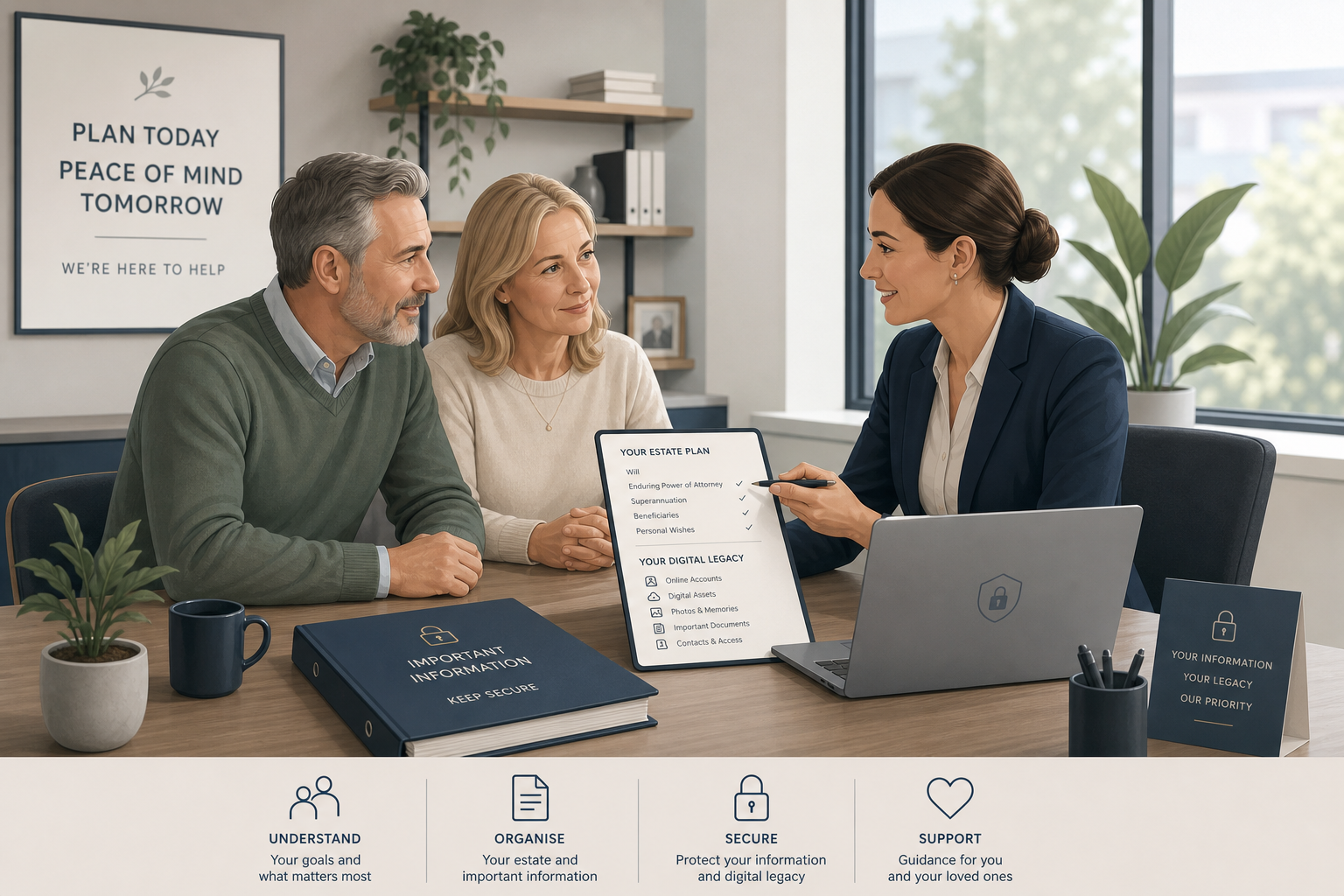
A simple step-by-step process to organise your digital legacy
1. List your digital assets
Make a full inventory across finance, admin, sentimental, and business categories.
2. Decide what each person needs
Think in terms of recipients, not just accounts.
3. Separate access from visibility
Not everyone should receive everything.
4. Record instructions clearly
Explain what exists, what matters, and what should happen.
5. Align with your will and legal documents
Make sure your executors, attorneys, and professional advisers know a digital plan exists.
6. Use secure storage
Choose a platform built for sensitive information, not a workaround.
7. Set a review rhythm
Review after major life changes and at least annually.
Why modern families are moving towards low-maintenance digital planning
The best systems are the ones people actually keep up to date.
Families are busy. They need something that is:
simple to set up
secure by design
easy to revise
clear for recipients
not dependent on memory
not burdensome month to month
That is why low-maintenance check-ins matter. They keep the plan active without turning it into an administrative project.
Final thoughts
Digital asset planning is no longer a niche exercise for highly technical households. It is part of responsible estate planning in the modern world.
The legal landscape is catching up, particularly in the UK, with the Property (Digital Assets etc) Act 2025 reinforcing the importance of digital property. But the family challenge remains practical. Loved ones and advisers need a secure way to locate information, understand your wishes, and receive only what they need, when they need it.
That is where Holdfast stands apart.
It combines zero-knowledge architecture, client-side AES-256 encryption, controlled recipient-by-recipient sharing, automated delivery after multiple missed check-ins, and a calm, dependable user experience. It supports credentials, documents, letters, legal details, and video messages. It is suitable for individuals, couples, families, and professional advisers. It is built in the UK, hosted in the EU (West EU, Ireland) under UK GDPR, which the EU recognises as providing an equivalent level of protection - users worldwide are welcome, and data is processed to those standards regardless of where you are based.
If you want to organise your digital legacy once, properly, and give your loved ones real peace of mind, Holdfast is a practical place to start.
Start with a secure plan, not a patchwork fix
If your current plan relies on memory, paper notes, or hoping someone can work things out later, it is time for something stronger.
Holdfast offers:
Free
Personal, £5/month or £45/year
Family, £9/month or £79/year
Firm, £39/month or £399/year
For modern families, the goal is simple. Keep sensitive information private now, make essential information available later, and remove avoidable stress for the people who matter most.
That is what good digital estate planning should do. That is what Holdfast is built for.